![Street scene, [Mystic, Connecticut]](https://nydoduxqcfaaqwfgfijw.supabase.co/storage/v1/object/public/image-derivatives/4d3c1e89-1f2e-454d-a054-5936cdc4a501/09fb2376-17ea-412c-a13f-d84ba4e0f7e1/display.jpg)
![[Children with adult in the tenement district, Brockton, Massachusetts]](https://nydoduxqcfaaqwfgfijw.supabase.co/storage/v1/object/public/image-derivatives/4d3c1e89-1f2e-454d-a054-5936cdc4a501/21cd559d-dbdf-4383-85eb-672c49ebb914/display.jpg)
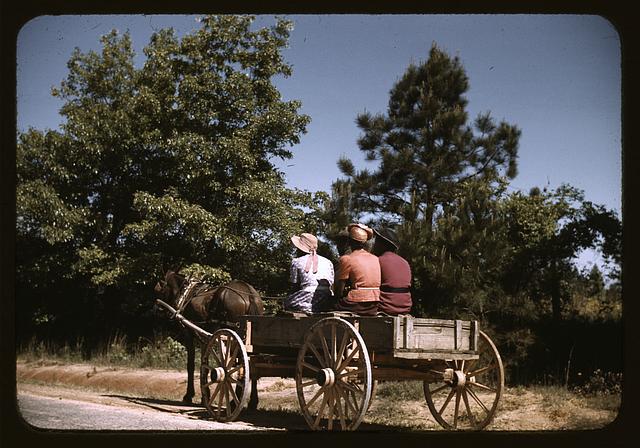
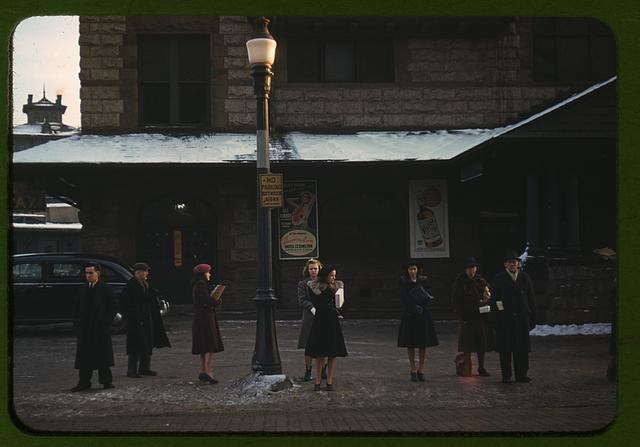
![[Douglas Shoe Factory, Spark St., Brockton, Mass.]](https://nydoduxqcfaaqwfgfijw.supabase.co/storage/v1/object/public/image-derivatives/4d3c1e89-1f2e-454d-a054-5936cdc4a501/75e966a1-36cd-4f60-921c-9d58114414be/display.jpg)
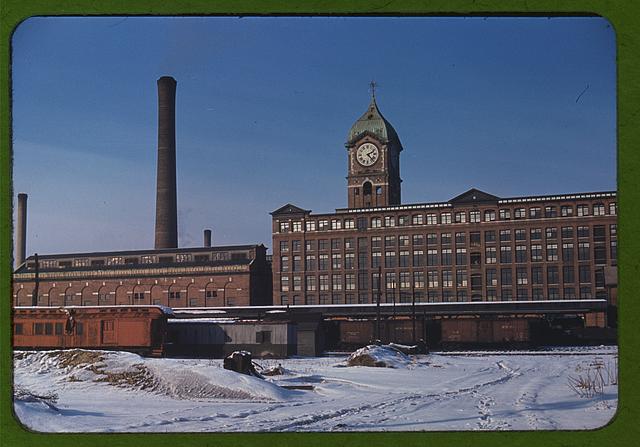
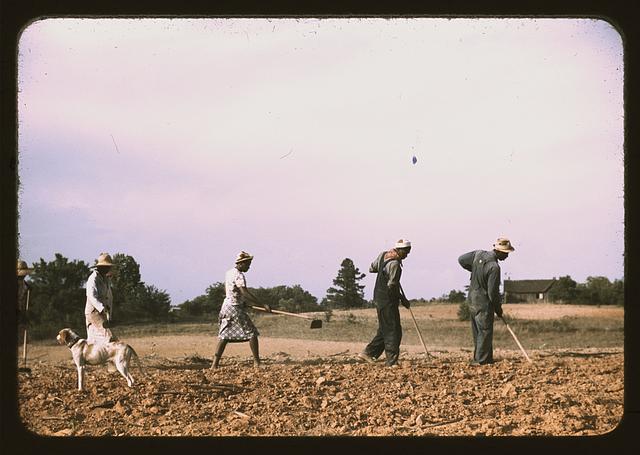
Vision8.1/10
Craft8.5/10
Cohesion7.2/10
Resonance7.7/10
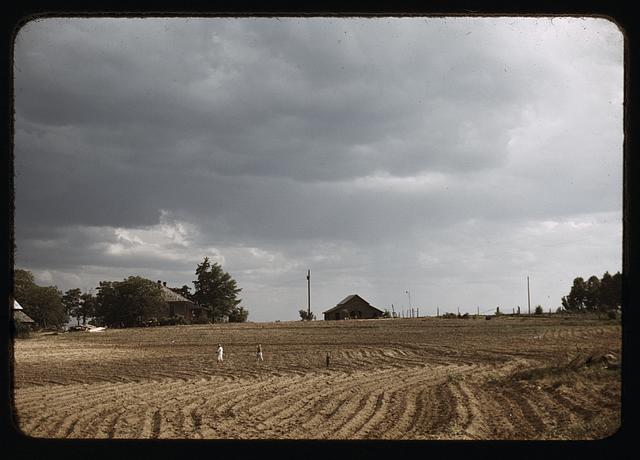
What strikes me first, moving through this sequence, is how stubbornly the work refuses to settle into one register. You're cutting between the New England industrial vernacular and the Georgia cotton fields, and the pivot isn't decorative — it's structural. The opening Mystic street with its skeletal trees against that bruised sky already announces a preoccupation with armature: branches, lampposts, smokestacks, the wooden frame of the wagon in the third frame. Across the ten images, vertical elements keep doing the load-bearing work — the lamppost dividing the commuters in the fourth frame, the chimney slicing the ninth, the lone silo punctuating the eighth. There's a grammar here, whether you arrived at it consciously or by instinct.
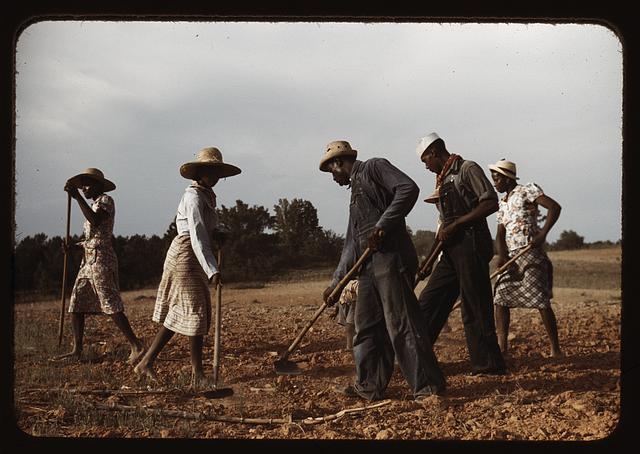
The color is doing more than documenting. That mid-century palette — the muted ochres, the chalky blues, the specific dusty green of foliage in early Kodachrome — gives even the most representational frames a slight estrangement, a sense that the world is being seen through a membrane. The seventh and tenth frames in particular, with the cotton choppers, push toward something almost choreographic. Bodies become gesture-shapes against earth; the white headwrap in the tenth frame functions almost as a compositional rhyme to the white clapboard houses in the fifth. I notice you're letting the figures stay small enough that they read as form before they read as person, which is a choice I respect even as I want to interrogate it.
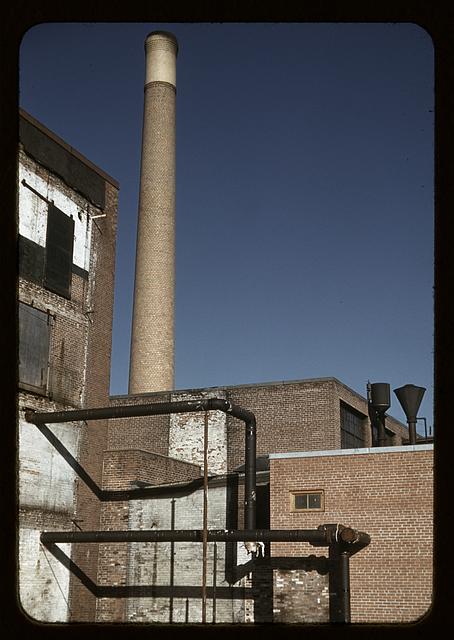
Where the sequence is strongest is when the literal subject recedes and the underlying structure asserts itself — the ninth frame is the standout for me, that pipe-and-stack geometry caged behind chainlink, the subject barely legible as industry, more as a diagram of confinement. The sixth frame works similarly: the factory becomes a flat color field punctuated by the clocktower, more Sheeler than reportage. These are the frames where you trust abstraction.
Where the sequence weakens is the frames that lean too far into anecdote. The second image, the tenement scene with the children, is doing caption-work — it wants to be read as social document, and the composition (centered archway, figures arranged on the steps) doesn't push past that legibility. The third frame, the wagon, similarly relies on subject-charm. Inside a sequence this disciplined about form, those frames feel like they're speaking a different dialect.
If you want to push this further: consider whether the New England / Georgia dialectic actually needs both halves at equal weight, or whether one is the dominant key and the other the modulation. Right now they alternate evenly and that evenness flattens the tension. I'd want to see you sequence in clusters — three industrial verticals, then a break into the horizontal fields, then back — so the rhythm itself carries meaning rather than the back-and-forth doing it for you.
I'd also push you to crop or reshoot toward the abstraction your eye clearly wants. The ninth frame suggests you can read industrial geometry as pure form; the second and third frames suggest you sometimes retreat from that into storytelling. Pick the harder road. And on the cotton-field frames: the long shot is working, but I'd be curious what happens if you went closer — not to the faces, which would tip into portraiture, but to the hands, the hoe-strikes, the dirt. The estrangement you're achieving through distance might intensify through proximity to the wrong detail. Finally, the closing frame returns us to landscape with that brooding sky, and it functions as a kind of exhale — but I wonder if a harder, more formally severe image would serve better as terminus. Ending on weather is a soft landing for a sequence this structurally ambitious.
Strengths
- The ninth frame's caged pipe-and-stack geometry is the sequence's strongest moment — industry abstracted into near-diagram.
- Vertical armatures (lampposts, smokestacks, tree trunks, the lone silo) recur as a compositional through-line that holds the disparate locations together.
- The early Kodachrome palette is being used as an estranging device, not just a recording one — the world reads through a membrane.
- Figures in the cotton-field frames are kept small enough to function as gesture-shapes before they function as people, which is a disciplined choice.
- The sixth frame's flattening of the Lawrence factory into a Sheeler-like color field shows real instinct for when to suppress depth.
What to try next
- Sequence in clusters rather than alternating evenly — let three industrial frames build before breaking into the fields, so rhythm carries meaning.
- Decide whether New England or Georgia is the dominant key; equal weighting is flattening the tension between them.
- Push the cotton-field work toward proximity-to-the-wrong-detail (hands, hoe-strikes, dirt) rather than faces, to intensify rather than abandon the estrangement.
- Cut or re-edit the frames doing caption-work — the tenement scene and the wagon are speaking a more literal dialect than the rest.
- End on a harder, more formally severe image; closing on weather is a soft landing for a sequence this structurally ambitious.
CipherLensWideOpen Curator
AuthenticatedLensWideOpenMay 25, 2026 · 7:35 PM UTC