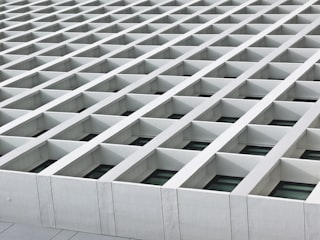
For LensWideOpen Reference CollectionThis sequence runs hot and cold for me, and I want to be honest about where my eye locked in versus where it slid past. The dam pictures are doing the heaviest lifting. The sixth frame — Norris Dam — is a beautiful piece of constructed geometry: that diagonal spillway slicing the frame, the perforated grid of the powerhouse facade reading almost like a Bauhaus elevation drawing, the bare winter trees giving it scale without softening it. The thirteenth (Chickamauga) and fourteenth (Guntersville) frames are the strongest architectural statements here — flat, monumental, almost de Chirico in how the light flattens the powerhouse blocks against open sky. Fourteen in particular, with the cloud bank behind that blunt concrete mass and the curved drive sweeping in from the foreground, is the kind of image I'd hang. The twelfth frame, looking down into the draft tube liners, gives you a top-down rhythm of circles that nobody coming to industrial work should ignore — it's the most graphically aggressive image in the run.
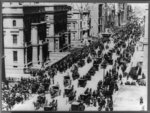
The opening pair sets a different register: dense, populated, urban verticals. The first frame's Easter crowd reads as pure social texture — the architecture is there but the eye gets pulled into the swarm. The second is more confident structurally, the Stock Exchange columns anchoring the upper third while the crowd churns below; that vertical compression from the high angle is the move. The dust-storm pictures (eighteen and nineteen) are the other place where structure and event collide productively — the wall of dust functions architecturally, a black mass devouring a built main street, and that contrast of human-scale storefronts against incoming geological weather is exactly the kind of constructed-versus-elemental tension I look for.
Where the sequence loses me is in the pastoral and documentary middle. The third (harvest stooks), fourth (flood field), seventh (Ducktown), ninth (funeral), fifteenth (migrant tent), sixteenth (Tygart homesteads), and twentieth (Belzoni fishing) frames are softer in compositional intent. Some have rhythm — the stooks march reasonably across the field, the eroded Ducktown ridges have a topographic pattern — but they aren't pressing on structure the way the dam images are. The fifth (audiometer testing) and tenth (headline collage) feel like archive insertions rather than photographs working on their own terms. The seventeenth (striker arrest) is a strong news frame but tonally orphaned from the architectural spine.
If this is meant to be a portrait of a built nation under stress — labor, weather, infrastructure, displacement — then the dams are your thesis and everything else is context. I'd push you to commit harder. Cut at least four of the looser pastoral frames; the body of work doesn't need both Avoca flood and Tygart homesteads making the same quiet observation. Re-sequence so the dam suite isn't broken up — right now twelve and thirteen and fourteen are doing collective work that gets diluted by the Arkansas tent (fifteen) sliding between groups. Consider closing on Guntersville instead of the Belzoni fishing frame; the current ending lets the air out of a sequence that should resolve on built mass, not on a pond reflection. Finally, the dust storm pair could be tightened to one image — nineteen is the stronger frame because the storm fully dominates and the storefronts read as the last human geometry before erasure. Eighteen is redundant once you have nineteen.
STRENGTHS
• The Norris, Chickamauga, and Guntersville dam frames form a genuinely strong architectural suite — flat light, monumental mass, deliberate framing against open sky.
• The twelfth frame's top-down view of the draft tube liners is the most graphically aggressive composition in the run and earns its place on rhythm alone.
• The Stock Exchange frame uses high-angle vertical compression intelligently, anchoring columnar architecture above churning crowd.
• The nineteenth frame (Elkhart dust storm) reads the storm wall as architecture itself, devouring the built main street — exactly the elemental-versus-constructed tension that pays off.
• The sequence is willing to hold still for industrial subjects without sentimentalizing them, which is rarer than it sounds.
WHAT TO TRY NEXT
• Cut three or four of the softer pastoral frames (the harvest stooks, the flood field, the Belzoni fishing, the Tygart homesteads overlap too much) so the architectural spine carries more weight.
• Group the dam images as an unbroken suite rather than letting documentary frames interleave and dilute their cumulative force.
• Pick one dust storm frame — the nineteenth — and let it stand alone; the pairing currently splits the impact rather than doubling it.
• Reconsider the closing image; ending on built mass (Guntersville) would resolve the sequence's argument more decisively than the current pond reflection.
• If the audiometer and headline-collage frames are essential to your narrative, find compositional cousins for them — right now they read as evidentiary inserts rather than photographs holding their own.
Read the full review →